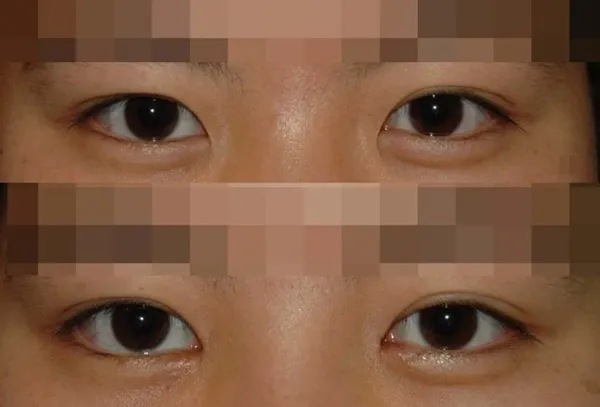
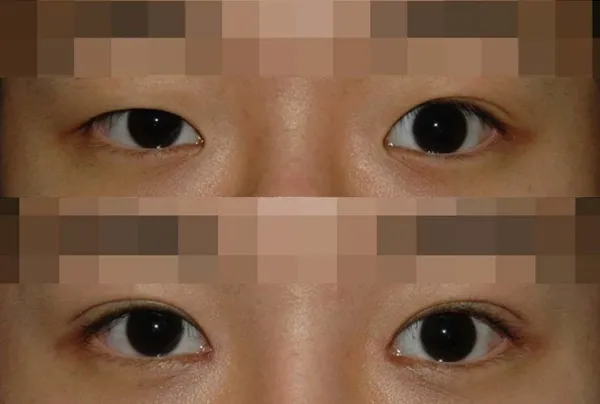
How do epicanthoplasty, lateral canthoplasty and lower eyelid lowering differ?
Among surgeries that make the eyes bigger, lateral canthoplasty enlarges the eye toward the outer corner and downward at the same time, and lower eyelid lowering enlarges it only downward.
Dr. Kim Sang-ho · Rococo Plastic Surgery
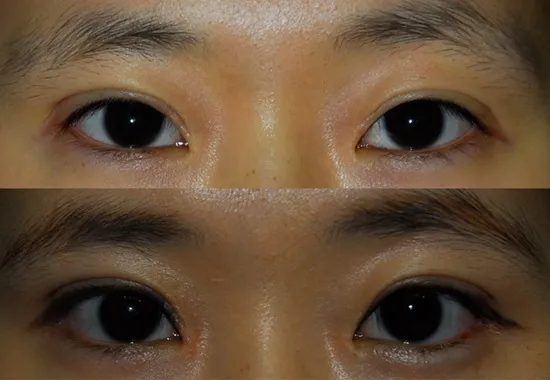
Rococo lateral canthoplasty that doesn't reattach — 2 years after surgery
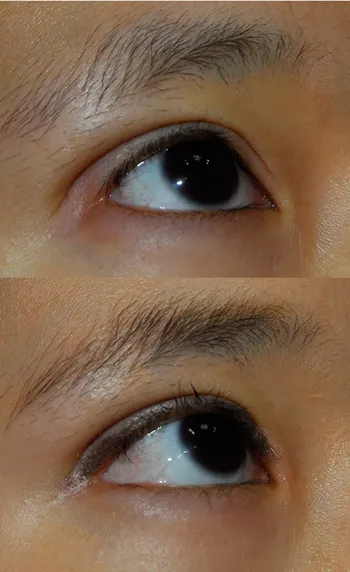
This page is an English translation of Dr. Kim Sang-ho's Korean columns. The original Korean text is shown under each quote.
Of those who want lateral canthoplasty, roughly 30–40% cannot have the surgery because there is no space at all or the space is narrower than 4 mm.
Among surgeries that make the eyes bigger, lateral canthoplasty enlarges the eye toward the outer corner and downward at the same time, and lower eyelid lowering enlarges it only downward. These methods show the best effect when the outer part of the eye looks closed off and stuffy, or when the outer corners are raised so much that the face looks fierce.
— Dr. Kim Sang-ho
눈을 크게 만드는 수술법 중에서 눈꼬리쪽과 아래쪽으로 동시에 눈을 키우는 방법은 뒷트임수술이 있고, 아래쪽으로만 눈을 키우는 방법은 밑트임 수술이 있습니다. 눈 뒤쪽이 막혀서 답답하게 보이는 경우, 눈꼬리가 너무 올라가서 사나운 인상인 경우에 가장 좋은 효과를 보이는 수술법입니다.
A person's outer eye corner (A) can never go beyond the outer edge of the orbital bone. If the outer corner is cut out past the edge of the orbit, only a scar of red mucosa remains behind the bone.
Lateral canthoplasty is not a surgery where you can adjust the length; the new outer corner must always be made by fixing it well at point B.
In the end, how much bigger the eye can become with lateral canthoplasty is not decided by the surgical method or skill; assuming the surgery is done properly, it is already decided.
— Dr. Kim Sang-ho
사람의 눈꼬리(A) 는 안와뼈 바깥쪽으로는 절대 나갈 수 없습니다. 안와 바깥쪽까지 눈꼬리를 찢으면 뼈 뒤쪽은 붉은 점막으로 흉터만 남게 됩니다.
뒷트임 수술은 길이를 조절할 수 있는 수술이 아니고, 무조건 새로운 눈꼬리를 B point 에 잘 고정해서 만들어주어야 합니다.
결국 뒷트임 수술에서 눈이 얼마나 커질 수 있는가 하는 것은 수술 방법이나 실력으로 결정되는 것이 아니고 정상적으로 수술했다는 가정하에 이미 정해져 있는 것이랍니다.
The biggest advantage of redraping-style epicanthoplasty is that the scar is less noticeable, but it has a drawback. The inner corner can be opened too much, leaving the front of the eye looking blown open; because of this, in the early 2010s a great many people suffered from excessive epicanthoplasty, and as a result a surgery called epicanthoplasty reconstruction was created — there were so many problem patients that plastic surgery clinics specializing only in epicanthoplasty reconstruction appeared.
The key to epicanthoplasty is to open the inner corner naturally while minimizing the scar and never overdoing it.
— Dr. Kim Sang-ho
리드래핑 방식 앞트임의 가장 큰 장점은 흉터가 눈에 덜 띈다는 것인데 단점이 있습니다. 너무 앞트임이 많이 되어서 눈 앞이 뻥 터지는 형태가 될 수 있다는 점인데요, 이것 때문에 2010년 초반에 과한 앞트임으로 고생하시는 분들이 정말 많으셨고, 그 결과 #앞트임재건 이라는 수술이 만들어졌는데 문제되는 환자가 얼마나 많았으면 앞트임재건 수술만 전문으로 하는 성형외과가 생겼을 정도입니다.
앞트임 수술의 핵심은 흉터를 최소화 하면서 절대로 과하지 않게 눈 앞을 자연스럽게 열어주는 것입니다.
Why is the perception so widespread that lateral canthoplasty recurs, that it reattaches? I think it is because there are so many half-hearted lateral canthoplasty methods.
In particular, a method called "non-incisional", which fixes the outer corner to the periosteum with a suture, was once widely performed, and since this method inevitably recurs, I think it also had a big influence on the bad perception of lateral canthoplasty.
— Dr. Kim Sang-ho
왜 뒤트임은 재발한다, 다시 붙는다 라는 인식이 널리 퍼져있는 걸까요? 그건 어중간한 뒤트임 수술법이 워낙 많기 때문이라고 생각합니다.
특히 비절개 방식이라고 해서 실로 눈꼬리를 골막에 고정시키는 수술법이 한 때 널리 행해졌고, 이건 필연적으로 재발될 수 밖에 없는 수술법이라 그런 부분도 뒤트임 수술에 대한 안좋은 인식에 큰 영향을 미쳤으리라 생각됩니다.
Whether lateral canthoplasty is possible can't be told from photos alone; I must feel the outer corner during the consultation to check the space between the current outer corner and the bone surrounding the eye.
Personally, I recommend the surgery when this space is 4 mm or more.
Because the method removes part of the tissue inside the eye, it does not reattach unless a wound forms from rubbing or the like while the surgical site is healing.
Lateral canthoplasty takes about 30 minutes,
and after surgery a slightly bulging bit of extra tissue is left at the outer corner; in most cases this softens in about 1 month, but it occasionally remains, and when it does, I simply correct it with radiofrequency at 1 month.
It is impossible to correct asymmetry 100%, but in many cases it can be improved to some degree.
With the lateral canthoplasty I perform, the angled part of the outer corner may become very slightly blunter, but you can consider that the opened part does not reattach to how it was, nor does it leave an unsightly, fully squared-off (ㄷ-shaped) scar.
This conjunctival swelling (chemosis) and conjunctival redness depend largely on constitution, so they cannot be completely prevented, but I take great care during surgery to minimize them.
Lateral canthoplasty takes about 30 minutes; in 50% of cases you can expect a recovery period of 1 week (stitches are removed at 1 week), and in 50% the white of the eye can become red and bruised or swell up like jelly, so recovery may take about 3 weeks.
You can see the white of the eye looks red and bruised; this is called conjunctival redness (hyperemia). Some people have no conjunctival redness at all, and in some the white of the eye turns completely bright red. There are also cases of conjunctival swelling (chemosis), in which the white of the eye swells up like jelly.
After surgery, the inner lower part of the outer corner may look slightly kinked; this mostly settles down by one month, and after checking the progress at one month, I sometimes make a slight correction if needed.
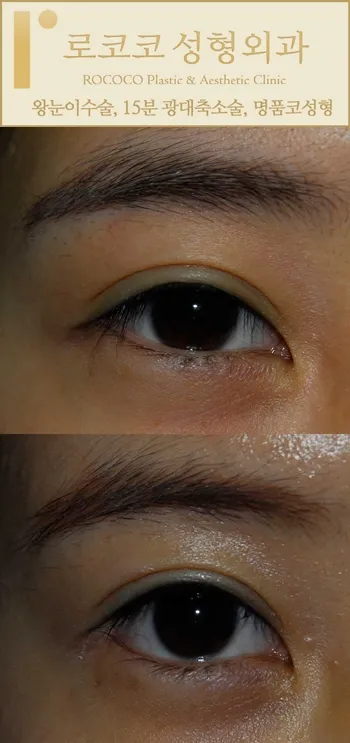
You can see the outer corner has healed so cleanly that it barely looks operated on.
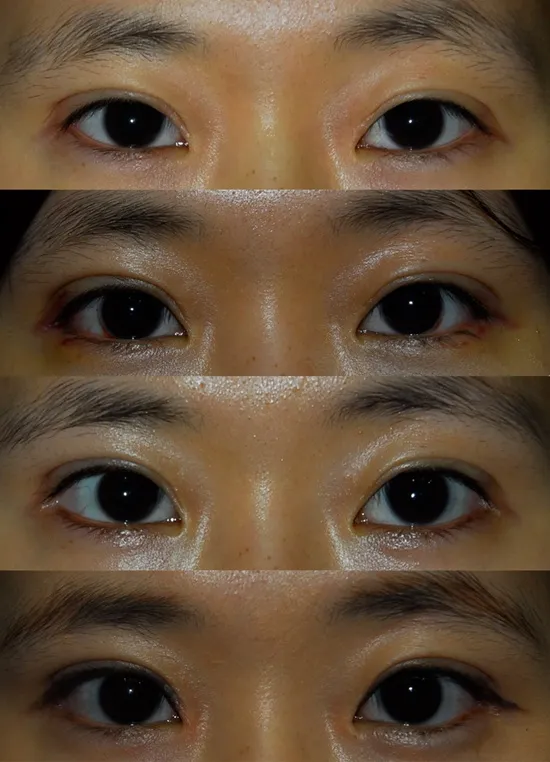
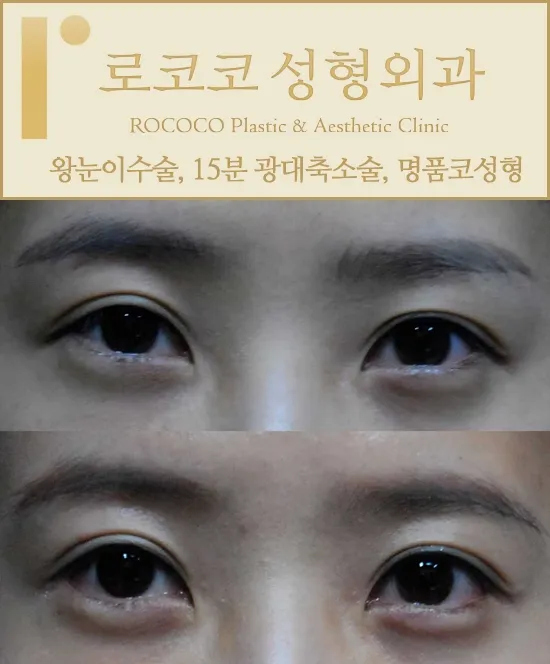
Before surgery and 2 years after. The outer part of the eye has opened up nicely and is well maintained.
Very rarely (about 2%), a small reddish area may remain at the outer corner; this can happen when the space between the eyeball and the orbital bone (the bone surrounding the eyeball) is wide. The redness fades over time, but a little may remain.

Lateral canthoplasty, front · 2 years

Lateral canthoplasty, outer corner · 2 years

Lateral canthoplasty, progress over time

Lateral canthoplasty + lower eyelid lowering · 3 years

Right eye · 3 years

Removing the epicanthal band

Redraping epicanthoplasty

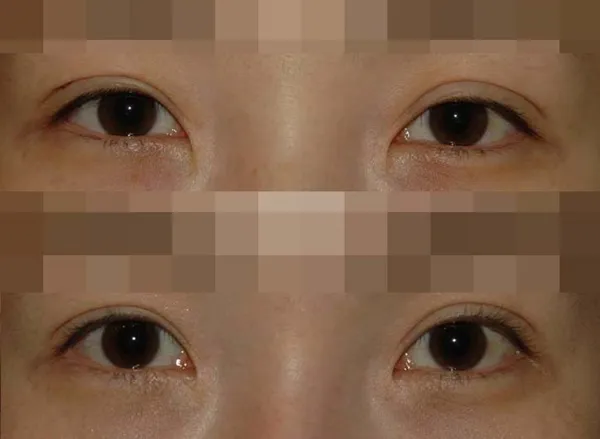
Double eyelid + epicanthoplasty
Results vary from person to person.
Early after surgery, within 2–3 weeks before the wound heals, there has been about one case in 5 years where the fixed outer corner was rubbed during sleep or the like, the fixation suture came loose, and it had to be re-fixed. Excluding such special cases, you can consider that the lateral canthoplasty method I perform does not recur.
Personally, I recommend surgery only when the A–B distance is 4 mm or more; when it is 3 mm, I explain that the effect will be small and let the patient choose. When the space is narrower than that, I advise against surgery. For such people, even if they have surgery at another clinic, they would just be paying to leave a scar on their eyes.
Lower eyelid lowering used to be done with an incisional method, but for the past 7–8 years I have been doing it non-incisionally. Again, the surgery takes about 10 minutes; it softens the look of the eyes and can make the midface look shorter. Doing aegyo-sal (under-eye roll) filler together makes the midface look even shorter.
The epicanthoplasty scar at the inner corner of the eye fades considerably after 6–12 months.
Whether there are eyelashes on the newly made outer corner was once an issue; the method I use is not one that pulls the outer corner and hooks it to the periosteum (that method causes a lot of ㄷ-shaped complications) but one that fully opens the outer part, so the newly opened area has no eyelashes, but if you look closely at the photos, the existing eyelashes point backward, so it does not look awkward at all.